

.png)

.png)

.png)


18/09/2026
Ben Phillips
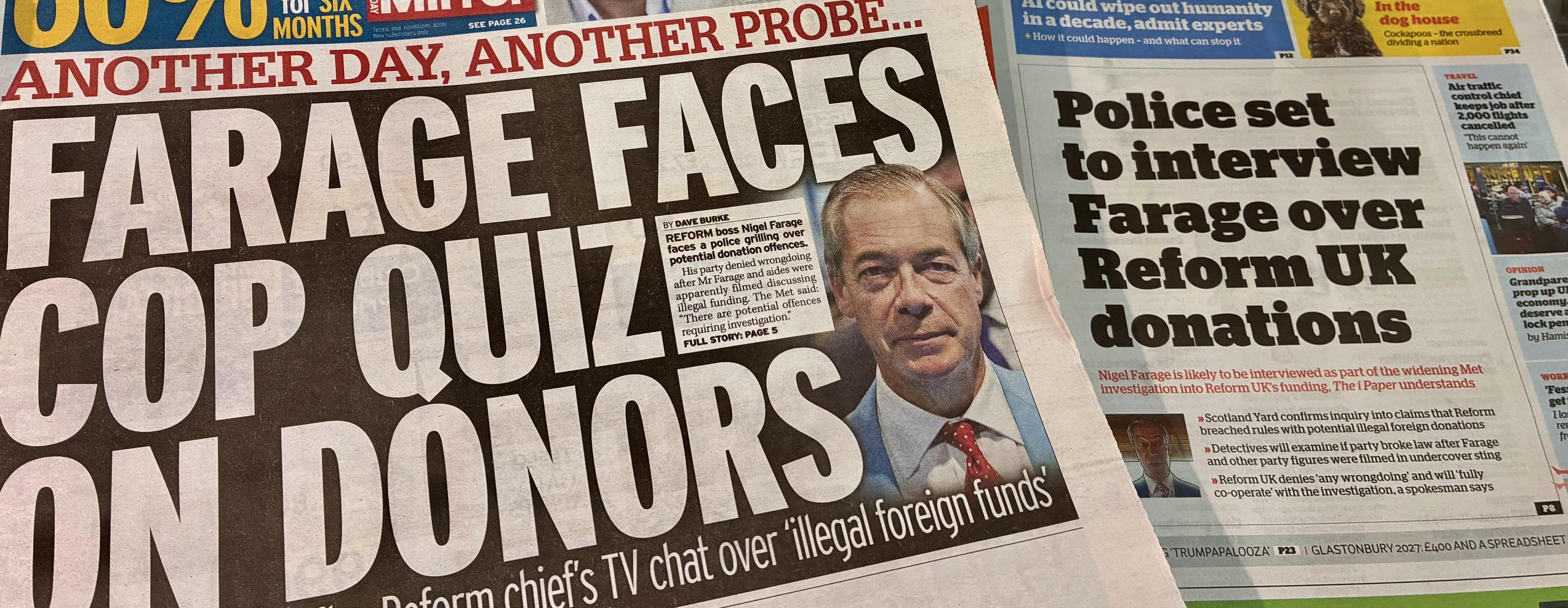
The polling industry has found itself under the spotlight after Channel 4 broadcast an undercover investigation into alleged foreign funding of a political party. The investigation involved a journalist posing as the son of a wealthy potential donor from the United States. According to the programme, senior figures in Reform UK discussed using money from the supposed foreign donor to fund opinion polls carried out by polling company JL Partners. Those polls were then reported on by national newspapers, including The Times and The Telegraph, without readers being told of Reform UK’s role in arranging them.
It is a prime example of why transparency around opinion polling matters.
At the time of writing, an investigation is underway into whether electoral law was broken over the source of the funding and the British Polling Council, the polling industry body, has confirmed that JL Partners breached its rules by failing to identify the client commissioning the polling. But there is a third aspect to this story, concerning the behaviour of the media: why did The Times and The Telegraph publish articles about these opinion polls, sometimes prominently on their front pages, without establishing and publishing basic facts about the polling, such as who had commissioned it and what respondents had actually been asked?
Polling is an important tool to gauge public opinion, but there can be instances where it is used to influence and generate positive news headlines for whomever commissioned the poll. Questions may be framed to lead a participant’s answer or false binary choices may be used to sway a poll in favour of a result desired by whomever commissioned it. This is why transparency is important and promoted by the British Polling Council. Knowing who commissioned the poll, what questions were asked and what methodology was used helps a reasonable reader assess what the poll actually shows and the possible interests behind it.
The British Polling Council publishes a guide for journalists accompanied by a video featuring Professor Sir John Curtice, a person many of us will recognise from General Election analysis programmes, discussing how to analyse poll data and what to look out for. In the video, Professor Curtice says the following:
“…just to use your critical common sense; just to look to see what’s being asked, and if that press release doesn’t tell you what’s been asked, ring up and ask… and ask what was the question being asked here and form a judgement as to whether or not you actually think this request was a question that simply begat the answer or whether actually this does presents a fair picture of what people might think”.
This is not asking for specialist data analysis skills, simply that if basic data is missing, ask for it…
In the case of The Times and Telegraph, such critical common sense has been shown to be lacking, and their reporting would suggest that they fail to see the importance of opinion poll transparency. Articles on opinion polls are often published without revealing who paid or commissioned the opinion poll and what specific questions were asked. In January, this blog examined another Times article on an opinion poll conducted by JL Partners, this time concerning HS2 and again intersecting with Reform UK campaigning.
In this instance, JL Partners did identify the commissioner as Knox Digital, although questions remain about whose interests Knox Digital were acting on behalf of. The Times did not identify the commissioner of the poll, nor publish the questions asked and, as the blog argued at the time, inaccurately framed the conclusions that could be drawn from the poll. They refused any change to the article to clarify its origins to their readers and correct the conclusions. The morning after The Times article was published, the poll and the resulting Times article were then the basis of a coordinated advocacy campaign, involving an anti-HS2 campaign group, the TaxPayers’ Alliance, Reform UK and JL Partners.
In secretly filmed footage, James Johnson, co-founder of JL Partners, gives us insight into how these opinion poll stories get published. Talking about one of the suspect polls subsequently published in The Telegraph, the footage showed him claiming it was “informal rule bending” and that they “should have disclosed who the client was”. He was then asked how it had worked with The Telegraph and how the results were published on the front page with the Telegraph claiming the poll was their own. Mr Johnson replies:
“It’s that kind of like… got a good story for you here. For them, it’s copy. So you know, it’s fantastic. Exclusive…Can we call it an exclusive?…”
When asked why the poll was published as “commissioned by The Telegraph”, he says they never ask whether they can do that, they just do it anyway. More surprising still is that he confirms The Telegraph have no idea the poll is actually commissioned by Reform UK and says, regarding them finding out: “that can never happen. We would never let that happen”.
That matters because concealing the interested party changes how the polling appears not only to the reader, but, as Mr Johnson’s comments indicate, potentially to the publishing newspaper itself. A poll openly commissioned by Reform UK about Reform UK would naturally attract scrutiny. Presented instead as a newspaper exclusive, it can look like independent evidence of public opinion. The newspaper appears not to question the missing information about the poll, such as who commissioned it, and instead goes ahead and publishes the “exclusive”.
In response to the Channel 4/Verbatim allegations, The Telegraph has said, “We are reviewing our future relationship with this polling company, as we believe we have been misled… As a matter of precaution we have suspended the relevant articles while The British Polling Council conducts a review”.
The Times has not suspended or noted the relevant article(s) at the time of writing and said it “was not made aware of Reform’s involvement in commissioning and arranging payment of the poll”.
This is not good enough. The failure of both titles to do due diligence on a story handed to them, to not even check on the missing opinion poll data, allows this manipulation to happen. Similarly, when responding to a complaint last year about the failures on reporting the HS2 poll mentioned above, the Times replied:
“The poll came from JL Partners and was commissioned by Knox Digital. JLP is a respected organisation that is a member of the British Polling Council and follows its guidelines. You do not identify any inaccuracy”.
An appeal to IPSO, the “independent” complaints body for The Times, simply said “The Committee noted your concern related to the reporting of polling data”. There was no further comment on any point about The Times’ reporting of opinion poll data.
A promise of an exclusive, a misplaced trust in a pollster, a failure to follow BPC advice on reporting opinion polls, a failure to publish important information, a lack of journalistic verification or, perhaps more concerning for journalists, a lack of inquisitiveness: this is how polling commissioned by interested parties can be laundered as independent polling and find its way into national newspapers. After what Channel 4/Verbatim’s investigation has revealed about parts of the polling industry, we should expect newspapers now to understand why such transparency matters.
Hacked Off is funded by supporters, not newspaper owners. Help us take this to Parliament: give £10 a month.
Give £10 a monthBy submitting your details you agree to receive email updates about the campaign. We will always keep your data safe and you may unsubscribe at any time.

.png)
.png)