

.png)

.png)

.png)


16/08/2026
Professor Paul Wragg
Professor Paul Wragg, Professor of Media Law, University of Leeds.
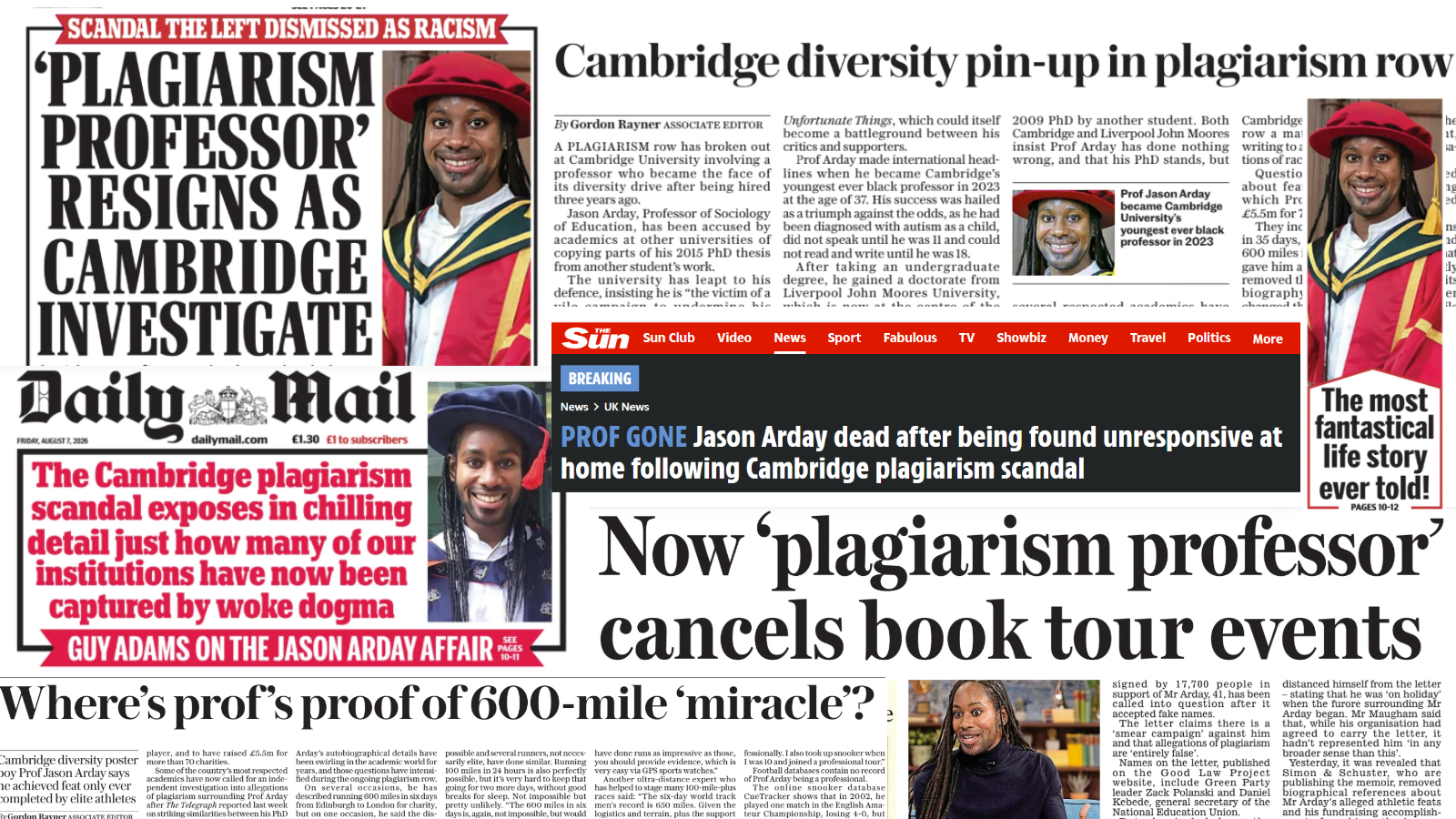
The sense of public outrage about the late Professor Jason Arday’s treatment by the press is palpable. The government would do well to listen. As Newscord reports, Professor Arday was the subject of 249 articles in 22 days – but, crucially, 188 of those came after his impassioned plea to be left alone: ‘While criticism is an inevitable part of academic life, what I have experienced has gone far beyond scholarly disagreement. The relentless accusations, speculation and public commentary have taken a profound toll on me and on those I love.’ Such unwavering, withering press scrutiny should be the preserve of the Prime Minister, not an ordinary member of the public.
Rightly, Dawn Butler MP has called upon IPSO to investigate: ‘It is clear to many of us that newspapers regulated by IPSO played a central role in the unacceptable public hounding of Jason… Surely, at this moment, every lever available to IPSO must be used.’
Those familiar with IPSO’s dismal performance know what will happen: performative utterances will follow, muted expressions of regret, and (probably) an ill-judged defensiveness, steeped in the noble language of public interest journalism. All will be expressed in contingent, solemn tones – and may even be genuinely felt – but no real change will happen. Just as the self-same press hounded Caroline Flack in 2020, so too it will find its next victim sooner or later.
Why is that? Why are we doomed to repeat this endless cycle of tragedy in which, in Leveson’s words, ‘real harm’ happens to ‘real people’? The reasons are legion, but the core ones are easily stated.
It may not monopolise the popular and political agenda in the way it once did, but the infrastructure remains. We are not much more advanced than we were in Victorian England, in which the electorate, their political representatives, and the press could all be found, more or less, somewhere between Westminster and the Square Mile. Newspapers still drive the conduit between politician and public (hence they campaign for a greater cut of internet revenue for republication of their work). They still have those cosy relationships with politicians, in which press owners seek to dictate the terms of a Prime Minister’s mandate. They are still unaccountable, except by private citizens rich enough to afford legal redress.
Although it was Professor Arday who suffered, it was Jack Grove of the THE who claimed to be the real victim when discovered he was under police investigation for four months after a complaint of harassment was received (an investigation Grove was entirely unaware of; he found out after it had been dropped), The Telegraph wrote a piece lauding Grove and condemning the police (for doing their job), enlisting the support of Tory MPs and peers, who demanded, predictably enough, that sackings should follow. “Journalists should be free to ask questions of anyone, even star professors,” said Grove.
Mr Grove told the newspaper that he had been “stunned” to receive a phone call from police to be told he had been investigated for what he believed was simply his job. The journalist was also reportedly told to stop contacting Professor Arday because the reporting had allegedly affected the academic’s “mental health”.
Note: the sneering insensitivity toward mental health indicated both by the speech marks and the caveat. Contrast that with the smug self-satisfaction with which the Editors’ Code of Practice Codebook (p 40) discusses mental health:
‘Mental health was already covered implicitly in the [Code], but [its] explicit [inclusion]… is a timely reminder of the changing attitudes in society – mental health is now openly acknowledged and the press can take some credit for driving that welcome transformation.’
This is the self-same press clamouring for even greater power to destroy lives by claiming that the immense powers the law already provides is not enough; that they need even greater protection because they are ‘victims’ of the SLAPP phenomenon (a phenomenon, we should note, that is often claimed but poorly evidenced). Sadly, there are just too many MPs gullible enough to believe that this is true.
As we know, it has powers to penalise ‘serious and systematic’ breaches of the Editors’ Code of Practice. It never uses them. Why? Because membership is entirely voluntary. If it were to use its powers, disgruntled members would leave and its future would be in jeopardy: just as happened when Northern & Shell left the Press Complaints Commission. Cynically, we might say the only lesson IPSO took from the Leveson Inquiry was not to piss its members off. Any outward appearance of toughness it may occasionally project belies an inner core of fear and cowardice. Indeed, to say it does not enforce its own rules is deeply misleading: it has no real control over the standards it is meant to oversee, since that is the sole preserve of the Editors’ Code of Practice Committee.
Perhaps this explains the clear mismatch between the outward appearance of its purported abilities, as stated on its website (‘We also have the power to launch a standards investigation to investigate serious concerns about the behaviour or actions of one or more of our members’) and the reality of the convoluted processes that its regulatory documentation imposes, for there are many procedural hoops that must be traversed before such an investigation can commence – not least the delay of at least six months (sometimes more) between complaint and adjudication and the necessity that there must be both serious and systematic breaches at that publication (terms that are not defined) and the complex terms of its regulatory documentation (see Reg 53). In short, it cannot simply leap into action when it has ‘serious concerns,’ as this public statement would suggest.
IPSO consistently has a serious identity crisis. It cannot decide if its role is to protect what might be called a floor of (legal) rights or else is to inspire ambitious standards journalism that reflect blue sky thinking. The question is: is it looking up or down? This confusion is evident in its own description:
‘We protect the public and freedom of expression by upholding high editorial standards. Our aim is that independent regulation by IPSO is a mark of credible and accountable journalism.’
What does this mean? Does it mean that it will protect the public only to the extent that free speech rights allow? If so, this restricts its purpose to an adjudicatory role in which it is bound by the law. Yet the device ‘by upholding high editorial standards’ would suggest that the law is not the guiding principle: that ethics, not law, is the lens by which it conducts itself.
In this sense, it can impose standards that transcend those found in law. Obviously, as we know, using coercive methods to achieve ethical ends is problematic. It does represent a prima facie interference with Article 10. Nevertheless, IPSO might achieve meaningful results if it put these ethical claims into greater practice, for stronger condemnation of such failings might drive press standards up; a regulator that was respected by all might help change public opinion and, therefore, drive economic incentives to honour the code. This, at least, seems to be the Scandinavian experience in which press standards are high despite the presence of purely voluntary schemes of self-regulation.
Clause 1 (Accuracy) is a case in point. It says: ‘The press must take care not to publish inaccurate, misleading or distorted information or images, including headlines not supported by the text.’ Although it has parallels with defamation law, it goes beyond the strict requirements of that law.
Consider this in light of Professor Arday’s situation. IPSO should say 188 articles in 9 days is a material distortion: the sheer magnitude of scrutiny conveys the impression of a very serious public wrong. As he told The Times:
‘I am accountable for the mistakes I’ve made. I hold myself accountable and other people should hold me accountable. We’re talking about academia here. I didn’t murder somebody. I think the cruelty that I’ve experienced and the positioning of me as this kind of liar and fantasist is totally unacceptable.’
The scale of press scrutiny was deeply misleading. It suggested something very grave had occurred. Why else would the press be so interested in alleged plagiarism? As the Good Law Project notes, there are plenty of examples of such allegations but they have attracted one critical article at most.
Yet there is no sign that IPSO adopts this perspective. This supposed commitment to ‘high editorial standards’ evaporates whenever it adjudicates. The evidence is too numerous to mention but take, eg, the notorious example of Katie Hopkins vile remarks about asylum seekers. For IPSO, this was just press freedom in action: complaint dismissed.
If IPSO’s role is no more than to apply legal principle, then its application of those principles is questionable.
In principle, there is cause for optimism. The code provisions broadly reflect English and Welsh law, relating to data protection, freedom from harassment, the entitlement to a private life and to reputation, and are found, principally, in clauses 1 (Accuracy), 2 (Privacy), 3 (Harassment) and 4 (Intrusions into Shock or Grief).
As a matter of law, the fact of a discernible public interest is not, of itself, determinative. The European Court of Human Rights, which provides us, through the Human Rights Act 1998, with rights to privacy and reputation (Article 8) and the right to freedom of expression (Article 10) is clear that these rights are of equal value; there is no presumptive priority for press freedom. This is reflected, in English and Welsh law, by the decision in Campbell v MGN Ltd. The two rights must be balanced to determine which is stronger on the facts; any interference must be proportionate and necessary in a democratic society.
This principle is well-expressed in the Editors’ Code of Practice Codebook (p 55) which says that, when determining the balance, IPSO will ask: 1) Is publication of the private information genuinely in the public interest? 2) Is the degree of intrusion proportionate to the public interest served?
Even if (which I do not accept) there was a genuine public interest in questioning Professor Arday’s academic record, the intense scrutiny was utterly and irredeemably disproportionate. He had resigned; he was under investigation by his employer – and (I’ll say again) 188 articles in 9 days followed.
Yet, as with judicial handling of this proposition, IPSO’s track record is not great: it tends to apply the public interest exception as a rule rather than understanding it as a balancing exercise. Thus, as we saw in the Hopkins matter, the presence of some conceivable public interest is usually sufficient to see the complaint dismissed. This need not be the case, though. IPSO (and the courts) should develop better analytical tools to test the proportionality of the interference with personal rights on public interest grounds. It may be hard to do in marginal cases; but not in Professor Arday’s situation. It was obviously disproportionate.
Sadly, the most telling reasons why it is so difficult to institute press regulation in this country are as true today as it has always been: First, politicians are afraid of the press. They fear for their re-election prospects if they agitate too vociferously for meaningful press reform. This is not mere cowardice: targeting press reform will distract from, and possibly undermine, efforts to create public confidence for their other reform initiatives, in which they see the press as a vital cog to that end.
Secondly, they are too easily swayed by all the old tropes about the value of a free press in a democracy. Thus, they tend to adopt an intuitive, unrefined view about the press that romanticises it whilst also projecting press freedom as a near absolute right. Reference is always made to the vital role of the press in “holding power to account” whilst, in reality, much of the British press devotes itself to lauding the questionable achievements of politicians, particularly those on the right. This limited (and limiting) appreciation of the right is a cause of constant frustration for anyone concerned about press standards. For we can still say, with Tom O’Malley and Clive Soley (Regulating the Press (Pluto Press, 2000), 179):
‘Proprietors and defenders of self-regulation invoked the fear of state control of the press when faced with measures that [would not have] that effect. Proprietors and editors tended to equate press freedom and freedom of speech with their [claimed] right to publish whatever they wanted…’
Or, as Tom Gibbons put it (Regulating the Press (2nd edn, Sweet & Maxwell, 1998), 279): ‘the press and its owners have been able [with great success] to exploit the reluctance of government to be seen to interfere with free speech in a democracy.’ In short: they have been able to clothe their own grubby interests in financial success at all costs in the respectability of a broader constitutional principle.
Politicians owe it to the electorate to see through these patently false claims; to realise that mandatory but independent press regulation is both necessary and compatible with press freedom; and to do better to ensure the public is adequately protected against press malpractice. Unless and until they do this, we are doomed to repeat the tragedy that Professor Jason Arday’s untimely death represents.
Hacked Off is funded by supporters, not newspaper owners. Help us take this to Parliament: give £10 a month.
Give £10 a monthBy submitting your details you agree to receive email updates about the campaign. We will always keep your data safe and you may unsubscribe at any time.
.png)

.png)