

.png)

.png)

.png)


28/08/2026
Professor Paul Wragg
On 25 August, The Times published a letter, signed by a group of national newspaper journalists and their advocates, attacking a guest blog written for Hacked Off by Professor Paul Wragg, Professor of Media Law at the University of Leeds.
Professor Wragg wrote the reply below and submitted it to The Times on 28 August. The newspaper declined to publish it.
The Times has published a number of articles in its own defence in recent weeks, following the death of Jason Arday. It has not been willing to publish the argument on the other side. Readers may draw their own conclusions about a newspaper which insists on holding others to account, but declines to put its own conduct before its readers for scrutiny.
28 August 2026
Dear Sir,
I read with great interest the letter of Messrs Young, Mackesy, Neish, Adams and others, of 25th August. In it, they described a blogpost I had written as a ‘reckless response’ to Professor Arday’s tragic death, that it contained ‘un-evidenced assertion[s]’, ‘call[ed] for the censorship of the press and the curbing of free speech…’ and neglected the ‘legitima[cy]’ of ‘subjecting his work and apparently untrue claims to public scrutiny’. They concluded that ‘emotional vulnerability cannot be given priority over the need to hold the powerful and influential to account in the interest of truth’.
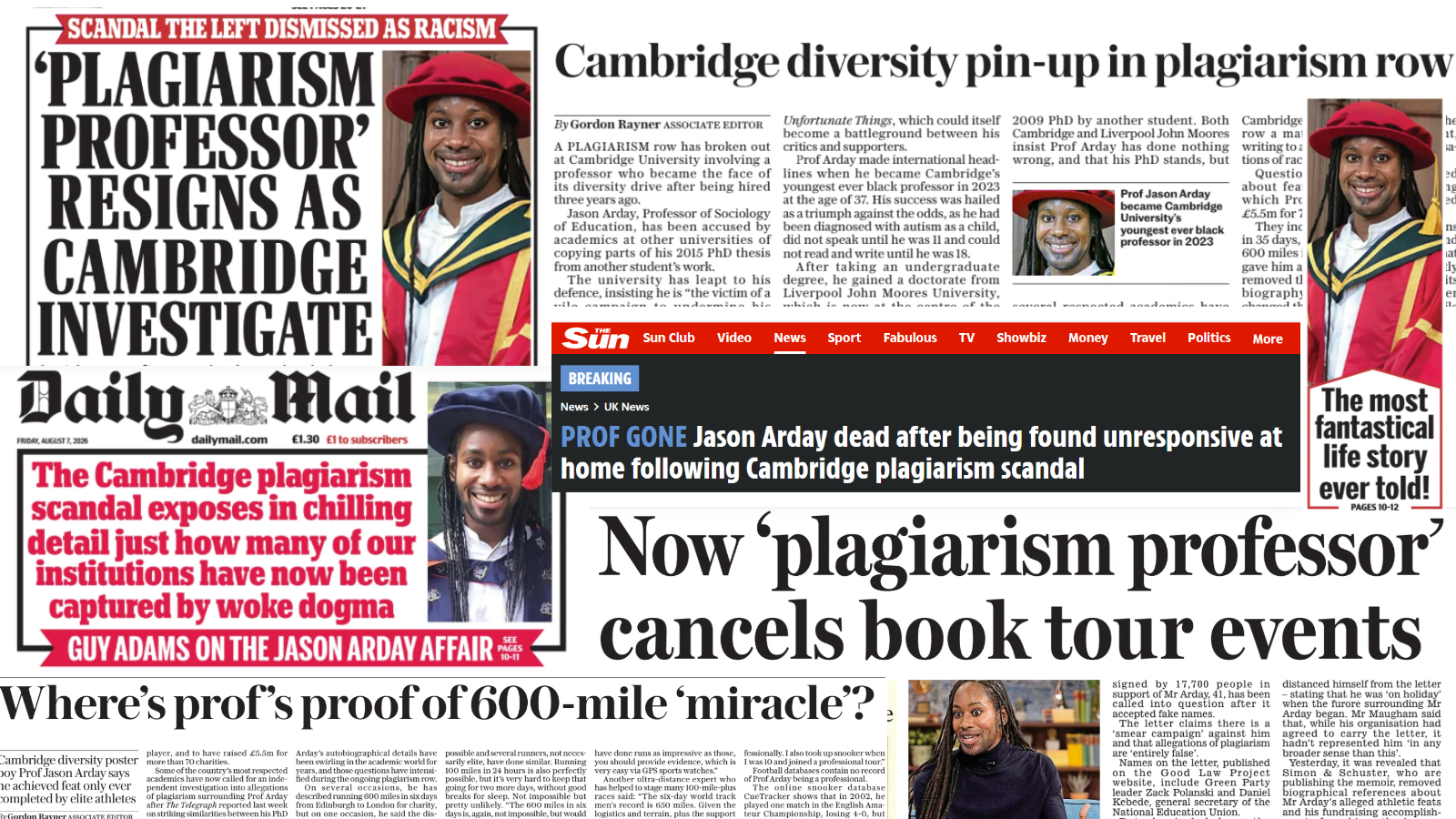
Far from being ‘un-evidenced’, the media’s role in the hounding of Professor Arday is clear and compelling. There was a barrage of hostile articles – some 188 in 9 days – after his resignation and his employer’s confirmation an investigation into the allegations had commenced. The link between this coverage and his death is plain to see.
The press, itself, is one such instance of ‘the powerful and influential’ that must be held ‘to account in the interest of truth’. It is right and proper to hold it to ‘public scrutiny’. Press freedom and free speech are vital to our society. Yet, as the Editors’ Code, to which the publications in question claim to adhere, makes clear, so is the general right of an individual to have ‘a private life free of intrusion’. Interference with this requires the degree of intrusion to be proportionate to the public interest served. After Professor Arday’s resignation there was no legitimate interest in ‘holding him to account’ whilst ignoring his vulnerability.
Effective independent regulation is not censorship – as IPSO itself admits. It involves applying the same standards of scrutiny that the press rightly seeks to apply to the powerful and influential – though not, it would appear, to themselves.
Yours faithfully,
Professor Paul Wragg
Professor of Media Law
University of Leeds
Hacked Off is funded by supporters, not newspaper owners. Help us take this to Parliament: give £10 a month.
Give £10 a monthBy submitting your details you agree to receive email updates about the campaign. We will always keep your data safe and you may unsubscribe at any time.
.png)

.png)