

.png)

.png)

.png)


19/08/26
Corinne Fowler
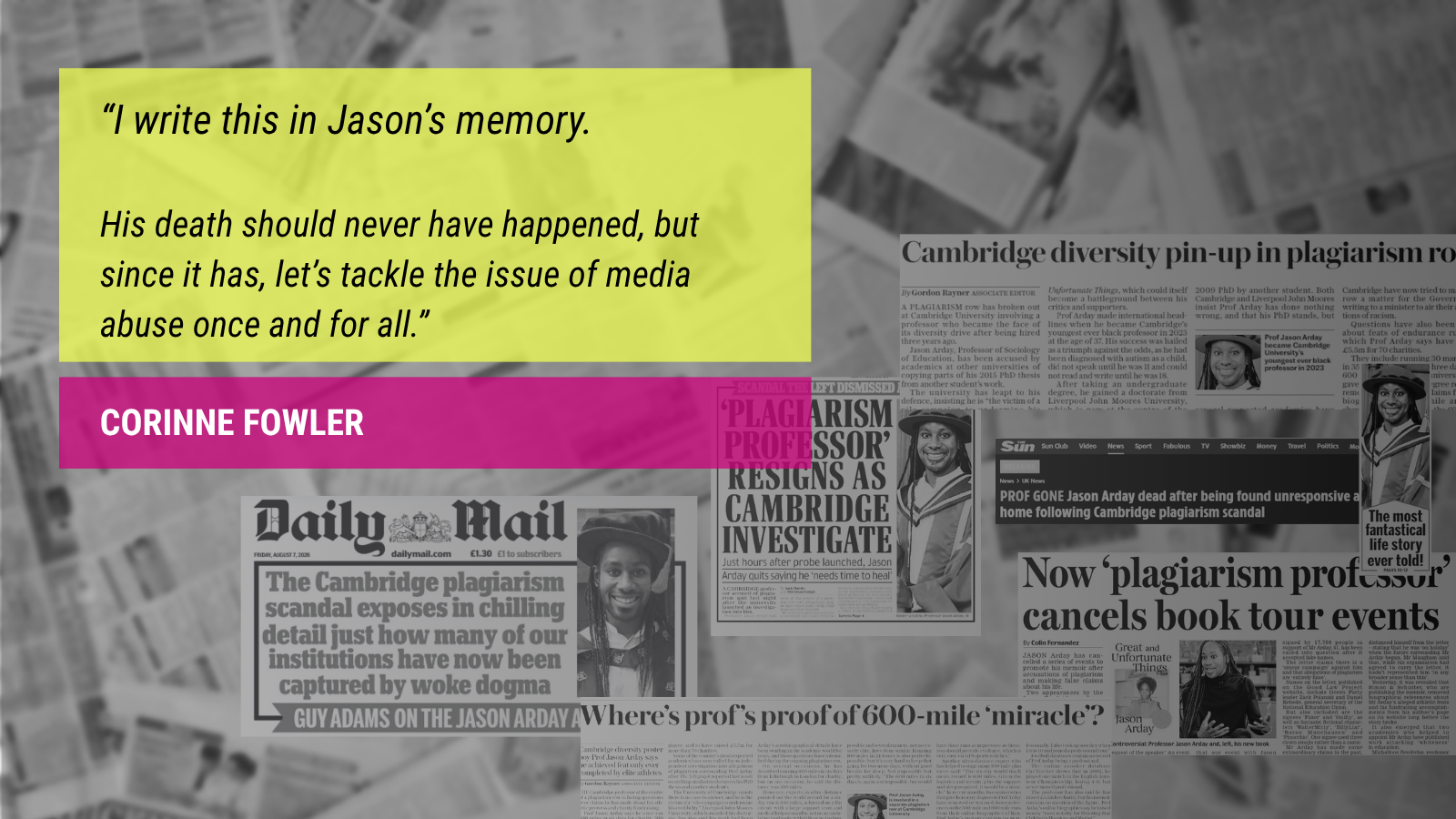
Jason Arday died on Friday 14 August. He phoned me just before he resigned as a Cambridge University professor nine days before that. Arday’s resignation followed accusations of plagiarism and charges that he had exaggerated his biographical details.
These kinds of allegations are common in academia, but they are internal matters that are handled through internal institutional processes.
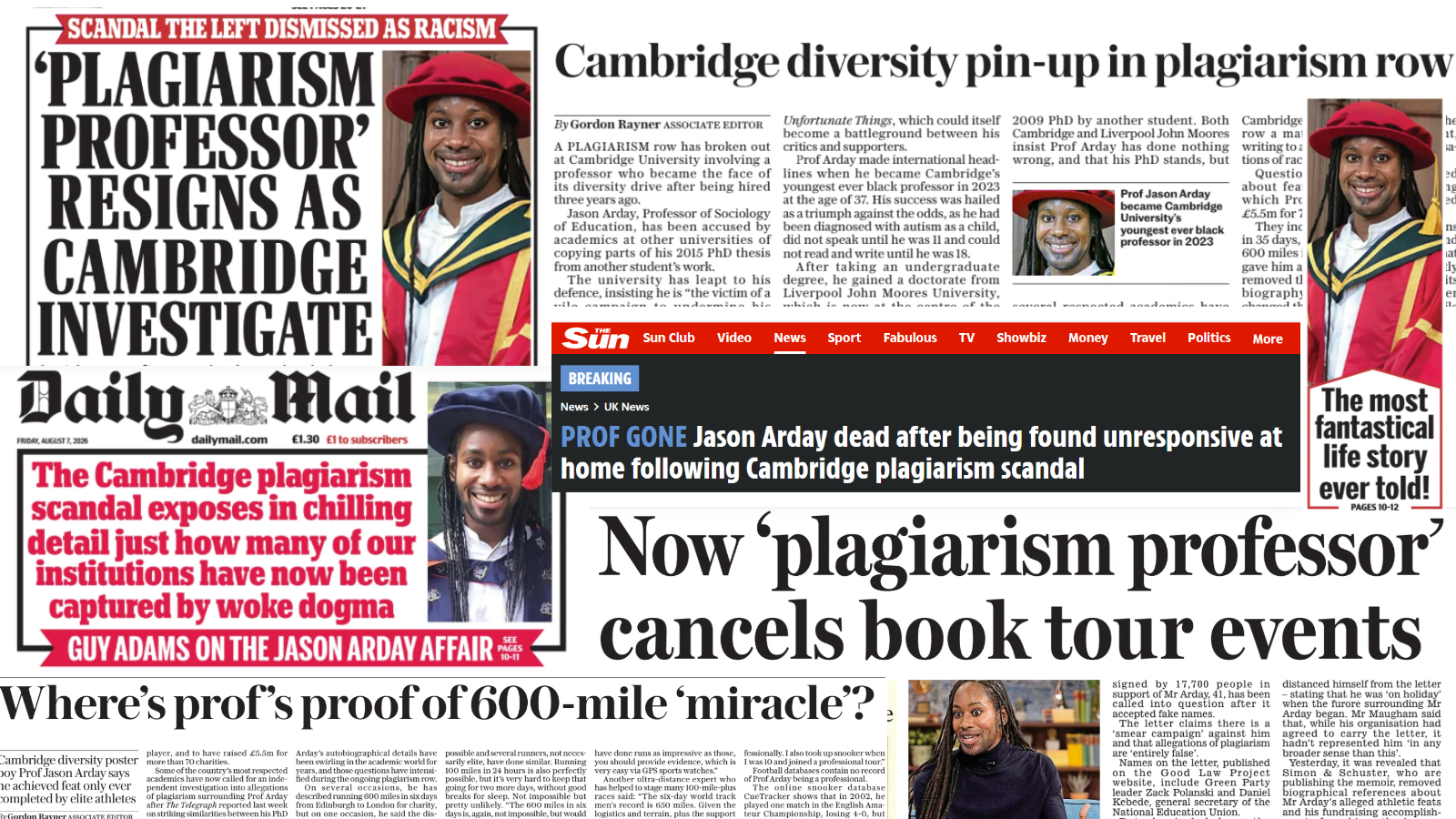
But, as a young Black academic at an elite institution, Arday came under intolerable scrutiny as commentators and journalists joined in the fray.
His case rapidly fuelled a culture war. Arday became a symbol of everything which was supposedly wrong with equity, diversity and inclusion (fact check: Black academics are woefully under-represented in professorial posts).
And so Arday’s case played out in the public domain. Even hostile journalists acknowledged that the string of accusations being put to him seemed to originate from an organised campaign against him by eugenicists and their allies.
Although the University of Liverpool John Moores – which awarded Arday’s PhD – vindicated him (and you would never have known this from the headlines), the row escalated as journalists picked holes in Arday’s online biography, achievements and institutional affiliations.
In response to the vicious media onslaught, academics from Cambridge, including Professor Priyamvada Gopal – herself a regular target of media abuse – asked Cambridge to review its appointment process on the grounds that it preferred one-off flagship appointments to a root-and-branch overhaul of institutional hires.
Their open letter was justified in the sense that there’s an embarrassment of riches when it comes to academics of colour who deserve professorial positions. But it doubtless added to Arday’s sense of isolation.
Arday phoned me in desperation because he wanted advice from a fellow academic who had experienced extreme media abuse. I myself suffered sustained journalistic attacks when I wrote the 2020 National Trust report on country houses’ connections to empire and was hounded by the press and subjected to relentless attacks for over a year.
Politicians and news commentators called me unpatriotic and politically biased. In one case, a commentator for the Telegraph claimed that I ‘lacked intellectual heft’ despite a proven track record of world-leading publications. None of this mattered to them.
The expression “do not confuse me with facts” could not be truer than it is for the gutter press and its unscrupulous pursuit of guaranteed clickbait.
One headline from the Daily Mail depicted me with a bird on my head, a photograph that had been taken from my Facebook page without permission. Many journalists cared neither for my safety nor my hard-earned professional reputation.
Meanwhile, members of the public sent me threats by text, post and email each time a new article came out to denounce my work. The experience was so much worse than I can describe in an article like this. I feared for my safety; it was psychologically devastating, and I am lucky to have survived.
Listening back over Jason’s last messages to me, it is clear that the media abuse drove him to his death. I feared this would be the outcome at the time.
Universities need to learn the right lessons from Arday’s death. The wrong lesson would be to abandon all attempts to ensure that universities embrace Black talent. Another wrong action would be to protect the university’s reputation at the expense of academic freedom or the individual academic’s right of reply.
There is a large-scale PR campaign against universities running in the popular press and concerted attempts to present universities as hotbeds of “woke” silliness. Universities need to defend themselves for what they overwhelmingly are: serious institutions which conduct rigorous academic research, much of which is focused on public benefit.
University leaders need to accept that, today, media abuse of academics is the norm, not the exception. It is a daily occurrence, not a once-in-a-blue-moon event.
Media abuse is disproportionately directed at academics of colour, women and others with protected characteristics. These attacks happen daily, and, for the victims, the experience can be unbearable.
I was fortunate enough to contribute to the “Hostile Responses to Research Policy” designed by my own institution, the University of Leicester.
This policy outlines the steps the university needs to take to address media abuse, which plagues both junior and senior academics, against anyone who conducts research into sensitive topics these days, which include race, the environment, colonial history and transgender issues.
Universities need to be proactive in identifying – and asking staff to pinpoint – any research which might become a target of media abuse. This ensures that plans are made to mitigate against any risk and – since this is sometimes impossible without curbing academic freedom – to implement a system which responds with swift action.
The university needs to identify and appoint first points of contact – senior members of staff – who are available at all times, not just during the week: media stories often break at the weekend.
The first question to ask an academic in this situation is “Are you ok, and what do you need?” The onus should not be on the victim to organise everything and participate in endless meetings. They have enough to deal with.
Following planning for episodes of journalistic attacks, a team needs to be deployed at short notice to proactively offer support and advice about security, research reputation, press dis/engagement, internal and external comms, the university’s formal response, legalities and workload relief. Counselling should also be offered, especially in severe cases.
Under pressure, a university’s instinct is generally to protect itself rather than the individual. This can be unethical and often betrays the principle of academic freedom. A university should be careful to protect the academic’s privacy and take care not to throw the person under a bus: in most cases academics are attacked for doing their jobs.
A supportive public statement goes a long way towards easing the pain and reputational risk for the individual concerned.
Because of my experiences with the press, I have become a go-to person for academics who are experiencing press abuse. In almost all cases their institutions have offered them minimal or no support.
The first step in changing things is admitting there is a problem. Universities have a duty of care to the academics who so frequently find themselves persecuted by an unscrupulous press which operates without meaningful independent regulation, effectively getting to mark its own homework through self-regulation.
Until there is another Leveson enquiry into press intrusion and harassment, this situation is set to continue. Universities must resolve to protect their staff and not bury their heads in the sand.
I write this in Jason’s memory. His death should never have happened, but since it has, let’s tackle the issue of media abuse once and for all.
Corinne Fowler is an honorary professor of colonialism and heritage at the University of Leicester, UK.
This article is a commentary. Commentary articles are the opinions of the author and do not necessarily reflect the views of Hacked Off.
Hacked Off is funded by supporters, not newspaper owners. Help us take this to Parliament: give £10 a month.
Give £10 a monthBy submitting your details you agree to receive email updates about the campaign. We will always keep your data safe and you may unsubscribe at any time.
.png)

.png)